The NBA has released the findings of its nearly yearlong investigation into the LA Clippers and Kawhi Leonard, punishing both for violating salary cap circumvention rules when the team signed Leonard to an extension in 2021.
The league released a statement Wednesday outlining that the investigation found “multiple significant rules violations by the Clippers organization.”
Punishments include a $30 million fine and suspension for owner Steve Ballmer (one year), plus suspensions for team president of business operations Gillian Zucker (one year without pay) and president of basketball operations Lawrence Frank (six months without pay).
The Clippers must also forfeit first-round picks in 2029, 2030, 2031, 2032 and 2033. Add the picks sent to the Oklahoma City Thunder in 2019 to acquire Paul George and secure Leonard’s free agent signing, and LA will have given up a total of 10 first-rounders to acquire and retain Leonard.
What does this all mean for Leonard, Ballmer and the future of the Clippers franchise? What will become of the agreed blockbuster trade to send the star forward to the Toronto Raptors?
ESPN’s NBA insiders examine every angle of the league’s shocking announcement.

How did the NBA come to this decision? How did it arrive at this punishment?
A significant part of this case appears to come down to the words “affirmative” and “responsive” as it pertained to how Leonard and the four companies arrived at endorsement deals.
In the investigator’s report and in the Clippers’ subsequent publicly released response, each side accuses the other of a flawed theory in how interactions between Leonard and the four companies were handled.
The Clippers believe their actions, connecting interested companies to Leonard for possible endorsement deals, constitutes a role as a middleman, which is permitted by league rules.
The investigators do not believe this and presented findings that they feel show the team flagrantly and repeatedly broke cap circumvention rules — and that the Clippers took actions to make it appear, through emails, that they were acting within the rules.
The report repeatedly rejects the Clippers’ argument that the connections were affirmative and, in some cases, cites admissions by the companies themselves.
The details make for compelling reading. In the case of scoreboard maker Daktronics, for example, the investigators accuse the Clippers of directing a kickback from a massive scoreboard contract for Intuit Dome to Leonard in the form of an endorsement deal and even setting the terms.
In other cases, the report cites the Clippers paying millions in “consulting” fees shortly after Leonard’s endorsement deals were executed. The report doesn’t specify exactly how the investigators acquired this information but repeatedly cites interviews with executives of the companies.
This punishment is in line with the penalty David Stern levied on the Minnesota Timberwolves in 2000 for executing an under-the-table deal with Joe Smith, which included five lost first-round picks, a then-record fine of $3.5 million, and owner and executive suspension and lost pay.
As for the size of the fine, the league appears to have imposed the maximum allowed fine for cap circumvention, $7.5 million, and imposed it for all four companies it believes the Clippers conspired with to circumvent cap rules, resulting in a compounded fine of $30 million. — Brian Windhorst
The Wachtell report alleges Ballmer generally failed to “create conditions under which his organization abided by the NBA’s circumvention rules.”
It also says he “knowingly sought to help [Kahwi] Leonard obtain off-court income opportunities and, in at least one instance, engaged in a significant act of team facilitation.”
However, the report cites no specific evidence that would appear to implicate Ballmer directly. Instead, it connects the dots using the Clippers’ knowledge of demands from Leonard’s representative, Dennis Robertson, introductions between the Clippers and their sponsors, and communications regarding the latter.
The official reason the NBA gave for its conclusions and the level of punishment is the number and depth of the salary cap circumvention violations over the length of time the Clippers are accused of committing them.
According to investigators, contemporaneous notes from Frank indicate that Robertson complained to Ballmer that Zucker, the president of business operations, was making “introductions” for “bulls— deals,” and that “I have to get paid.”
Investigators cited the same notes as saying Ballmer told Robertson that Clippers staff were “collective workers to try and help [Leonard] achieve his financial goals.”
In addition to the notes written by Frank, who appears to have been given leniency for his cooperation, the report cites information that appears to have come from interviews with executives from the involved companies that created a compelling case.
The punishment was compounded by the Clippers being previous offenders during Ballmer’s tenure as owner. They were fined $250,000 for a similar accusation involving DeAndre Jordan in 2015. There was also a 2019 investigation into Leonard’s signing in which they were cleared of wrongdoing but subsequently warned and put through a seminar to remind them of the rules.
This penalty is indeed harsh, but it could have been worse.
In the case of Joe Smith and the Wolves in 2000, his contract was voided and his Bird rights were vacated.
Leonard will have to write a sizable check — $700,000 — but will not be suspended, and his contract and Bird rights remain unaffected.
The Clippers and the Raptors will be allowed to move forward in their trade process, one league source said. If the trade moves forward, LA will acquire two first-round picks in the deal. — Windhorst
Do the Clippers have any recourse?
In its announcement, the NBA said the league and the NBPA have agreed on the penalties and that they are final and binding for all parties.
In a statement, however, the Clippers said they “intend to vigorously challenge these findings and penalties through every avenue available to us and look forward to an ethical and impartial arbitration process.”
Ballmer’s attorney, David Kelley, wrote an additional statement to the league, saying, “We are exploring every legal remedy to address this gross injustice.”
Ballmer certainly has the means to commit resources toward clearing the team’s name, though it’s not immediately clear what those paths look like.
But it’s not surprising that the Clippers would want to take this approach. They’ve been publicly and privately adamant from the start that they did not funnel money to Leonard through Aspiration, and one source close to the team with knowledge of the investigation said — as ESPN previously reported — that it would “fight that to the end,” including through arbitration. — Baxter Holmes
What does this punishment mean for the Clippers’ future?
It means the Clippers have no access to first-round capital to use in a trade.
Trading center Ivica Zubac to the Indiana Pacers last February began the Clippers’ process of rebuilding their draft assets, which had been depleted because of the trades for Paul George in 2019 and James Harden in 2023.
The Clippers acquired two picks in the deal, including one that resulted in the selection of Keaton Wagler with the No. 5 pick in this year’s draft.
Before the NBA penalties were handed down, the Clippers had seven first-round picks over the next seven seasons, including four that were tradable. However, because of prior trades, LA had no control of its own first until 2030 (the Thunder have swap rights in 2027, the 76ers own the Clippers’ 2028 pick and have swap rights in 2029).
By losing five firsts (the 2029 pick coming from the Pacers, plus their own picks in 2030, 2031, 2032 and 2033), the Clippers’ lone future picks are the less favorable of their own, Oklahoma City’s, Denver’s (if 6-30) in 2027 and the 2029 pick, none of which can be traded.
The Clippers, however, could be getting some draft relief relatively soon.
As part of the agreed-to trade to send Leonard to the Toronto Raptors, the Clippers were supposed to receive unprotected first-round picks in 2031 and 2033.
The Clippers would not be allowed to trade those picks in future deals even if the Leonard trade goes through, because of the NBA’s Stepien rule, which states that no team may trade a future first-round pick if the result would leave the team without first-round picks in any two consecutive future years. — Bobby Marks
What does this mean for Steve Ballmer?
Ballmer has publicly and privately vowed to fight the NBA’s decision, but it remains unclear what his options are outside of the court system. It’s also unclear yet whether the NBA’s yearlong suspension for Ballmer takes effect immediately, or whether he could ask the courts or an arbitrator to step in before it begins.
The alternate governor of the Clippers is Ballmer’s business associate, Dennis Wong, who owns 1% of the team. Wong was named as an investor in Aspiration but is not mentioned in the release from the NBA on Wednesday.
This does not mean that Ballmer will have to sell the team, like former owner Donald Sterling did after being banned for life by NBA commissioner Adam Silver in 2014. Technically, Sterling did not have to sell the Clippers either. His wife, Shelly Sterling, decided to sell the team before the NBA’s board of governors could vote to remove him as owner. — Ramona Shelburne
Is there precedent for a team to be without its owner for an entire year?
Yes.
As part of the punishment from the Joe Smith salary cap circumvention case in 2000, the NBA suspended then-Minnesota Timberwolves owner Glen Taylor for one season. General manager Kevin McHale was also suspended for one season.
Other owners who have been suspended for a year or more for reasons other than salary cap circumvention include Donald Sterling (Clippers), Mark Stevens (Golden State Warriors) and Robert Sarver (Phoenix Suns). — Marks
What does this mean for Lawrence Frank? Who is running the Clippers’ front office in the interim?
The Clippers have not accepted the punishment and, therefore, have not named an interim leader of basketball operations.
However, it is likely that general manager Trent Redden, a respected veteran executive, will lead basketball operations.
If Frank is forced to sit out the next six months, the suspension will take him past the 2027 trade deadline but allow him to return in time for the draft, when the Clippers will have a first-round pick.
In that scenario, he will also be back in charge for 2027 free agency, when the Clippers are projected to have up to $50 million in salary cap space. — Windhorst
Who is Gillian Zucker? What was her role?
Zucker has been the head of business operations for the Clippers since Ballmer bought the team, and she was the point person on all four deals between the team sponsors who also had endorsement contracts with Leonard.
The report from Wachtell comes down harshly on her, concluding “when interviewed, she made misleading and false statements to investigators.”
In one particularly detailed section of the report, investigators wrote that when Aspiration co-founder Joseph Sanberg told her he wanted to explore an endorsement agreement with Leonard, she “told Mr. Sanberg that she would enlist a particular business agent to assist Mr. Sanberg in structuring the agreement — a business agent who was then under a retention agreement with the Clippers.”
One day later, the report concludes that Zucker reached out to the business agent to help Sanberg.
That agent then emailed internal colleagues about the deal — that Sanberg would offer Leonard $5 million, plus $7 million in stock, per year for four years as long as Leonard was with the Clippers.
The investigators concluded that Zucker improperly conveyed to the agent the proposed financial terms contained in this email.
The agent told investigators that neither the agent nor the agent’s internal team came up with those terms. All relevant witnesses [including Zucker] agreed that Sanberg could not have come up with those terms because he didn’t have experience structuring player endorsement deals. — Shelburne
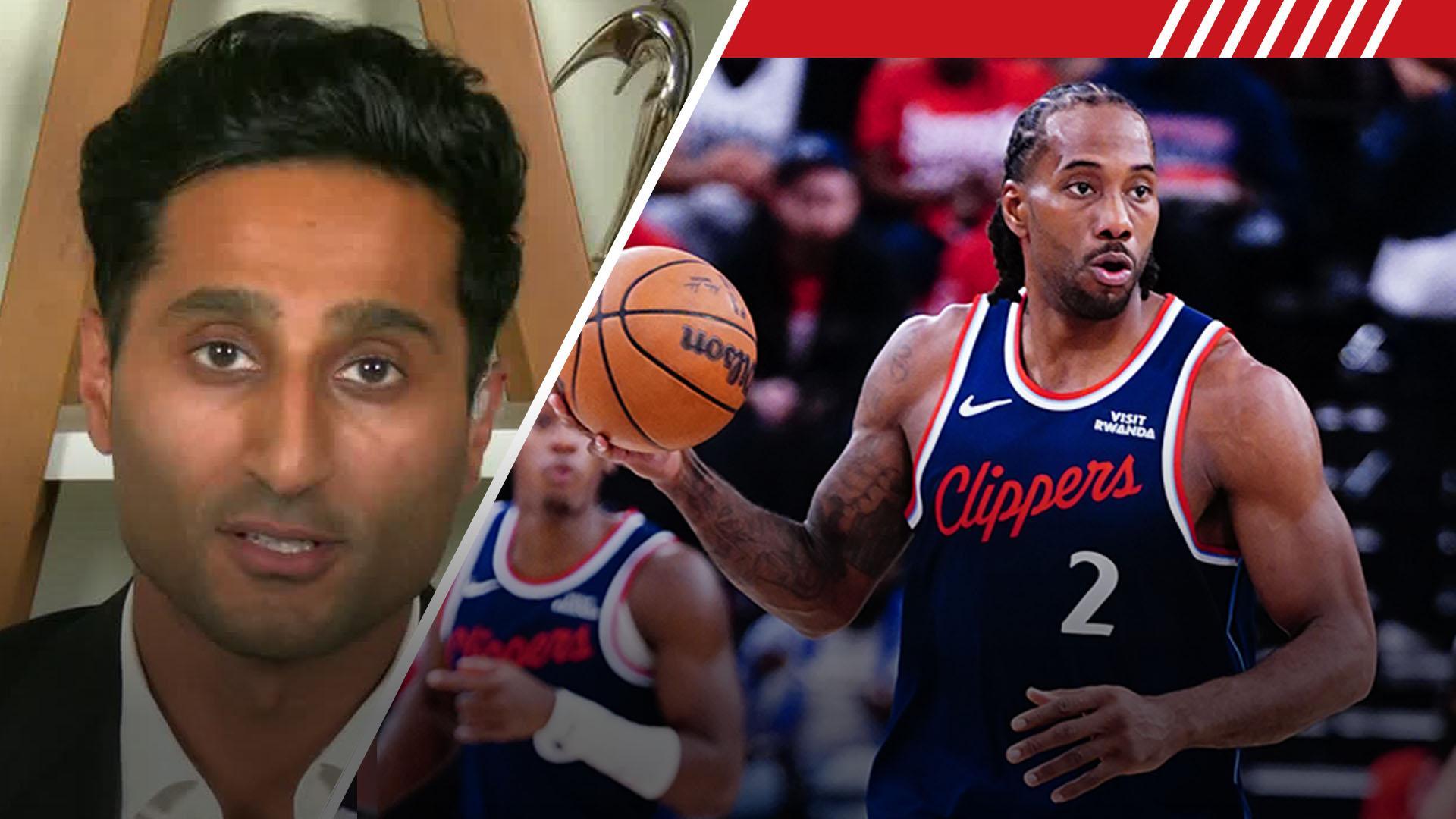
2:28
Shams details punishments for LA Clippers after Kawhi probe
What does this mean for Dennis Robertson?
The NBA announced that Robertson, who has been a controversial figure in league circles for years, will face a five-year ban “from conducting business or otherwise engaging with NBA teams and their affiliates on behalf of or with respect to any player, employee, or other league or team personnel.”
Robertson is Leonard’s uncle and for years served as his business adviser.
He was also directly involved in Leonard’s dealings with teams, including — most notably — his free agency negotiations with teams in 2019, during which Robertson made improper asks of the Clippers, including part ownership of the team, access to a private plane, a house and guaranteed off-court endorsement money, one source with direct knowledge of the talks previously told ESPN.
They were the same requests that, according to The Athletic, Robertson made of the Lakers and the Raptors. The Toronto Star reported Sept. 9 that Robertson also asked the Raptors for ownership stakes in outside companies and corporate sponsorship deals in which Leonard wouldn’t have to do anything in return for the money.
These verbal requests fell outside the boundaries of the league’s collective bargaining agreement, and word of them made waves around the league — and reached the league office.
“As a direct result of Mr. Robertson’s conduct on behalf of Mr. Leonard and the controversy surrounding the player’s signing with the Clippers,” the report from Wachtell Lipton noted Wednesday, “the NBA enacted a ‘rules enforcement initiative’ intended to promote better awareness, compliance, and enforcement of the circumvention rules.
“Among other things, this initiative included the adoption of the following rule:
“Teams are required to report to the league office any solicitation by a player of compensation or other benefits that are not authorized under the CBA. This includes any solicitation made by a player himself, by the player’s agent, or by any other person acting (or purporting to act) on the player’s behalf. Reports must be made even if the solicitation is rejected.”
In July, ESPN’s Shams Charania reported that Leonard hired Harrison Gaines of Slash Sports as his new agent and as someone who would lead all his business affairs. Gaines replaced Leonard’s previous agent, Mitch Frankel, and the informal role that Robertson previously held.
In his statement Wednesday, Leonard alluded to Robertson in the opening paragraph:
“Integrity and respect for this game are fundamental to who I am. I accept full responsibility for lapses in judgment by people within my inner circle and regret the distraction this situation has caused the fans and my family.” — Holmes
Is there precedent for the Clippers to get some of their picks back?
Yes.
In 2000, Minnesota lost its next five first-round picks for violating salary cap circumvention rules with its illegal attempt to sign Joe Smith.
Three years later, however, the NBA gave the 2003 and 2005 first-round picks back to the Timberwolves, leaving them without picks in 2001, 2002 and 2004. — Marks