
Introduction: UK economy bigger than first thought after GDP revised higher
Good morning, and welcome to our rolling coverage of business, the financial markets and the world economy.
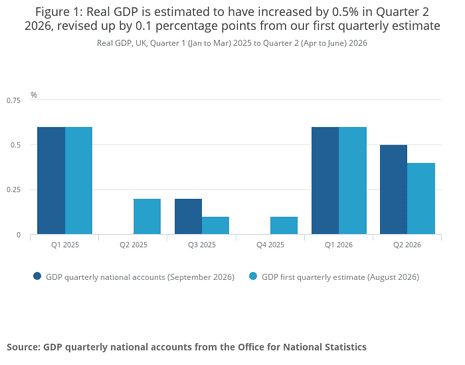
The UK economy grew faster than first estimated in the second quarter of the year, despite the disruption caused by the Iran war.
UK growth in April-June has been revised to 0.5%, up from the previous estimate of 0.4%, in the latest National Accounts.
That's a welcome piece of good news for chancellor John Healey, as he draws up the budget due in four weeks' time, and means his predecessor Rachel Reeves handed over a slightly larger economy than previously recognised.
Growth in Q2 2026 was driven by the services sector (where activity increased by 0.6%) and the construction sector (which grew by 0.8%), while the production sector shrank by 0.1%.
However…the Office for National Statistics, which publishes the data, has also revised down its estimate for growth in 2025.
ONS director of economic statistics Liz McKeown said:
double quotation mark “Today's figures include our annual improvements to the measurement of the economy, incorporating new information that provides a better picture of activity across the UK's service sector, alongside the usual inclusion of updated and improved data sources.
“Growth for 2025 as a whole was a little lower than previously estimated, with the profile of growth across the quarters also revised.
“However, stronger services growth in the latest quarter means the economy is now slightly larger than previously estimated.â€
The agenda
-
7am BST: UK national accounts for April-June 2026
-
7.45am BST: French inflation report for September
-
10:30am BST: BoE Financial Policy Committee minutes
-
1.30pm BST: US PCE inflation index for August
Key events
The Bank of England also highlights how the Middle East conflict has driven government borrowing costs to their highest levels in almost two decades, saying:
double quotation mark The re-escalation of the conflict and the associated rises in oil, gas and refined product prices are leading to a more protracted negative supply shock to the global economy.This has contributed to sustained increases in sovereign bond yields across a number of advanced economies, to levels not seen since 2008
Risks facing UK economy have risen since July, Bank of England warns
The risks of a financial crisis triggered by high energy prices and the AI boom have risen over the summer, the Bank of England is warning.
The Bank's Financial Policy Committee is concerned that the risk outlook has worsened since July; interconnected risks are more likely to crystallise at the same time, it says.
The minutes of the FPC's latest meeting, which took place on 25 September, highlight that the re-escalation of the Iran war has renewed uncertainty around growth and the path of interest rates in a number of advanced economies.
Policymakers are worried that vulnerabilities in government debt markets, high stock market valuations and risky credit markets “crystallise at the same timeâ€, which would create a crisis.
The FPC also flags that “rapid advances in AI capabilities have increased cyber and operational resilience risks†– a nod to the recent reports of AI agents going rogue.
However, they remain confident that UK households and businesses are resilient, and that the banking system is strong enough to support them in a stress.
The committee says:
double quotation mark The likelihood that interconnected vulnerabilities in the financial system crystallise has risen since the Financial Policy Committee's (FPC) previous meeting. The re-escalation of the conflict in the Middle East has renewed uncertainty around growth and the path of interest rates in a number of advanced economies, re-intensifying the risk that vulnerabilities in sovereign debt markets, risky asset valuations, and risky credit markets crystallise at the same time.The rapid increase in artificial intelligence (AI)-related debt issuance broadens the exposure of capital markets to developments in AI. At the same time, recent incidents in frontier AI have drawn further focus to the pace of AI development and associated vulnerabilities, including cyber and operational risks. The Committee underscores the importance of timely and careful management of these intensifying, interconnected risks.
The risk-on mood in the markets this morning is pushing up share prices and the pound.
Sterling has gained almost half a cent against the US dollar to $1.327, while the FTSE 100 share index is 30 points higher at 10,666 points.
UK gilts rally after growth surprise
British government bonds are rallying this morning, as the City welcomes the upgrade to UK growth announced at 7am.
With prices rising, the yields on short and long-dated bonds are both falling.
Two-year UK bond yields are down 5 basis points (0.05 of a percentage point) at 4.86%, while ten-year UK bond ields are 4bps lower at 5.356%.
Kathleen Brooks, research director at XTB, says the markets are in an “upbeat mood†as the UK economy surprises on the upside. A dip in the oil price is also helping.
Brooks says:
double quotation mark There was a double whammy of good news for the UK Gilt market this morning, with the upgrade to Q2 GDP, which was revised higher to 0.5% from the original estimate of 0.4%, This suggests that the UK economy was resilient to the effects the Iran war, the energy price surge and the rise in borrowing costs. Stronger services growth and rising household spending boosted the figure. This is fairly typical of the UK economy, which is service based, the real surprise was the strength of business investment and an improvement in the trade figures, which showed a boost in exports.GDP per head was strong too, at 1.1%, the highest level since the post-Covid boom, growth is now running at a 1.1% rate for the first 6 months of the year, which is the highest rate in the G7. The Gilt market likes what it hears, and is leading a major recovery in sovereign bonds this morning. The 2-year Gilt yield is down some 8bps this morning, and the 10-year yield is down 7bps. September has been a volatile month for global bonds, especially Gilts, and even with this recovery, 2-year Gilt yields are still higher by 30bps and 10-year UK yields are higher by 20bps.
Over in France, inflation has jumped this month.
Statistics body INSEE has estimated that the Consumer Price Index (CPI) should rise by 3.0% year-on-year in September, up from a 2.4% rise in August.
INSEE predicts that energy prices accelerated again, driven by those of petroleum products and gas.
Services inflation probably increased slightly thos month, while food prices are forecast to have accelerated, especially for fresh products.
On an EU-harmonised basis, French inflation jumped to 3.4% this month, the fastest pace in more than two years.
In another boost for the UK economy, Allianz Trade has upgraded its growth forecast for this year by 0.3 percentage points to 1.3%.
In its latest Global Economic Outlook report, the international insurance company explains that the UK economy has performed better than expected in 2026.
Allianz Trade says:
-
UK business insolvencies have fallen 5%, bucking a 6% global rise and increases of 19% in the US, 7% in Germany and Japan, and 5% in France.
-
Consumer spending and business investment have remained resilient, while manufacturing has rebounded and aerospace continues to power ahead.
-
Households have sustained spending by reducing their savings rate, raising questions over how long that resilience can last.
-
UK inflation is forecast to reach 3.4% in Q4 2026, as higher utility bills and input costs feed through to consumer prices.
-
The Bank of England is expected to raise rates twice before year-end, taking Bank Rate from 3.75% to 4.25%.
-
Rate cuts are not expected to begin until November 2027, with higher borrowing costs set to weigh on investment, housing and growth.
Zoopla: House sales down 9% in September
Higher borrowing costs hurt demand for homes in September, the property portal Zoopla has reported this morning.
Zoopla found that the number of sales being agreed this month fell by 9% compared with September 2025.
The drop in sales came despite the number of homes on the market rising by 5% year on year, with the gap between supply and demand most acute in London and southern England.
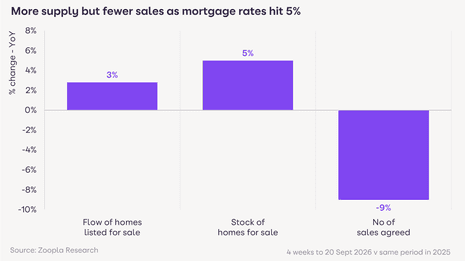
Annual house price growth has also slowed to 0.8%, the lowest level since July 2024, according to the latest Zoopla House Price Index. The average price of a UK home is now £273,000, it said.
GDP upgrade is ‘boost to Burnham’ but winter slowdown looms
This morning's upgrade to UK growth in April-June is a boost to Andy Burnham, analysts say, even though he didn't take office until almost a month later.
Chris Beauchamp, chief market analyst at IG, says:
double quotation mark “Still on a post-speech high, the upgraded figure is yet more good news for the UK's still-new(ish) prime minister.The highest growth in the G7 for the first half is certainly a headline and one that will help keep nervous MPs in line for a while, plus it helps take off pressure for a new election – why risk it now when things appear to be improving nicely.â€
Ashley Webb, senior UK economist at Capital Economics, warns though that growth may slow towards the end of this year:
double quotation mark The upward revision to real GDP growth in Q2, from 0.4% q/q to 0.5% q/q, suggests that the economy has been a bit more resilient to higher energy prices in the first half of the year than previously thought. This resilience may continue into Q3, but we still expect it to fade in Q4 as higher inflation takes a bigger bite out of households' real incomes.The 0.5% q/q gain in Q2 real GDP followed unrevised growth of 0.6% q/q in Q1, with the breakdown still showing that the economy is no longer being heavily supported by government spending, which contracted by 0.5% q/q (revised down from -0.3%).
Thomas Pugh, chief economist at audit, tax and consulting firm RSM UK, agrees that growth will slow over the winter:
double quotation mark “The upward revisions to Q2 GDP growth means the economy was even stronger in the first half of the year than we previously expected, despite the Iran war. What's more, the composition of growth looks a little healthier. Surveys suggest that much of that positive momentum has been carried forward into Q3 meaning we have revised up our annual GDP forecast to 1.4%.“However, the next six months looks tougher with potential interest rate rises, a sharp increase in inflation and another tax raising budget all to come. That will drag heavily on growth over the winter.
Greggs shares jump
Shares in Greggs have jumped by 7.5% at the start of trading after it announced a pick-up in sales, and plans to cut 740 jobs.
Investors are cheered that Greggs now expects “a modestly improved outcome for 2026â€.
Aarin Chiekrie, equity analyst at Hargreaves Lansdown, says:
double quotation mark “Greggs served up a tasty trading update, with total sales growth accelerating to 7.7% over the third quarter.This was driven by more settled weather in recent months, alongside ongoing menu development and product innovation. New store openings also played their part, with the group on track for 100-110 net openings this year, excluding 12 Express locations, making it easier for more customers to tuck into their freshly baked goods.
Alongside cost inflation remaining at a manageable level of around 2%, the full-year outlook has modestly improved from prior guidance, which had pointed to operating profits of around £188mn.
Encouragingly, the UK's exports in April-June were much stronger than first estimated.
Today's national accounts show that export volumes increased by 2.8% in the quarter, revised up from the first estimate of a 0.5% rise.
UK cements position as fastest-growing G7 country this year
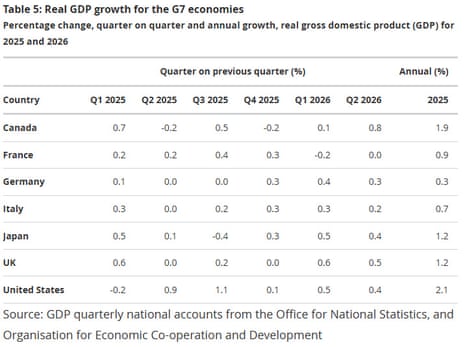
This morning's growth upgrade underlines the UK's status as the fastest-growing G7 economy in the first half of 2026.
Growth of 0.6% in Q1, and 0.5% in Q2, put the UK ahead of other advanced economies this year – although on an annual basis Britain shares third place with Japan:
Greggs proposes 740 job cuts
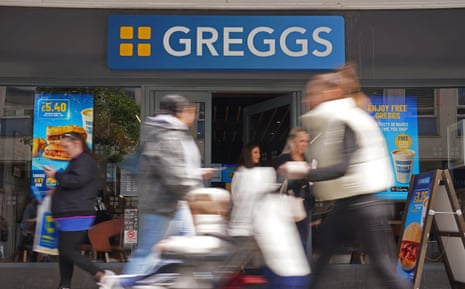
UK bakery chain Greggs has announced plans to cut more than 700 jobs, despite a pick-up in sales.
Greggs is proposing closing four of its production sites, which could lead to up to 740 roles becoming redundant.
Greggs warns that with signs of greater inflationary pressures in 2027, it needs to cut costs to remain competitive.
It says:
double quotation mark We believe such changes, whilst difficult, are necessary to ensure Greggs continues to meet capacity requirements for growth in the years ahead in the most cost-efficient manner. Our immediate priority is to minimise the impact on our people where possible. We will enter into a consultation period shortly to work with trade unions and employee representatives of those affected to refine and develop these proposals.
The proposals could cost £60m, but then save £20m a year.
Greggs also reported 7.7% sales growth in the third quarter of the year, which it attributes to “continued menu innovation†and more settled weather. Those menu changes includes its new Steak & Stilton Bake, and relauched salads.
Energy bills in Great Britain forecast to jump by £276 a year from January
Jillian Ambrose
Household energy bills in Great Britain are predicted to soar by £276 a year for the typical household from January as the impact of the Middle East war continues through the coldest months of winter.
The government's cap on energy prices is poised to jump by 16% to the equivalent of £1,999 for the average annual dual-fuel bill in a further blow to struggling households, according to figures from the leading forecaster Cornwall Insight.
The increase for the January to March quarter is well above the consultancy's previous prediction of a 9% rise, with analysts blaming the uptick on the recent rise in gas market prices to three-year highs.
It would take the cap to its highest level for four years.
UK business investment jumps as ‘AI-driven wave’ arrives
The AI boom may have driven UK business investment up in the April-June quarter.
The ONS reports that business investment is estimated to have increased by 1.8% in the quarter, and was 5.2% higher than a year ago.
Gross fixed capital formation (which measures the acquisition of fixed assets by businesses, governments, and households) rose by 0.9% in Q2; the main drivers of the growth are “increases in other buildings and structuresâ€, which would include data centres.
Martin Beck, chief economist at WPI Strategy, says:
double quotation mark “Consumer spending growth remained at the previous estimate of 0.3%, but business investment growth was revised up to 1.8%. That offers at least some evidence that the UK may be starting to catch the AI-driven investment wave very visible in the US.â€
Britons also put more money aside for a rainy day in April-June.
The household saving ratio increased by 0.2 percentage points to 8.8% in Quarter 2 2026, driven by a rise in the contribution of non-pension saving, the ONS says.
UK living standards picked up in April-June
An important measure of living standards jumped in the second quarter of this year, today's national accounts show.
Real household disposable income per head increased by 1.0% in April-June, following a decrease of 0.8% in January-March.
That means people had more money left to spend, save, or invest after taxes and deductions, adjusted for inflation.
Introduction: UK economy bigger than first thought after GDP revised higher
Good morning, and welcome to our rolling coverage of business, the financial markets and the world economy.
The UK economy grew faster than first estimated in the second quarter of the year, despite the disruption caused by the Iran war.
UK growth in April-June has been revised to 0.5%, up from the previous estimate of 0.4%, in the latest National Accounts.
That's a welcome piece of good news for chancellor John Healey, as he draws up the budget due in four weeks' time, and means his predecessor Rachel Reeves handed over a slightly larger economy than previously recognised.
Growth in Q2 2026 was driven by the services sector (where activity increased by 0.6%) and the construction sector (which grew by 0.8%), while the production sector shrank by 0.1%.
However…the Office for National Statistics, which publishes the data, has also revised down its estimate for growth in 2025.
ONS director of economic statistics Liz McKeown said:
double quotation mark “Today's figures include our annual improvements to the measurement of the economy, incorporating new information that provides a better picture of activity across the UK's service sector, alongside the usual inclusion of updated and improved data sources.
“Growth for 2025 as a whole was a little lower than previously estimated, with the profile of growth across the quarters also revised.
“However, stronger services growth in the latest quarter means the economy is now slightly larger than previously estimated.â€
The agenda
-
7am BST: UK national accounts for April-June 2026
-
7.45am BST: French inflation report for September
-
10:30am BST: BoE Financial Policy Committee minutes
-
1.30pm BST: US PCE inflation index for August