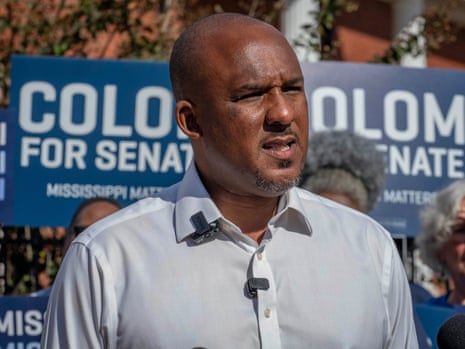
Andrew Bailey then hints that the Bank could well raise interest rates again, following today's hike to 4%, unless the Iran war ends.
He tells reporters in London:
double quotation mark Today's increase should not be seen as the first in an inevitable long sequence of hikes. That is not inevitable.But unless the conflict in the Middle East is resolved, neither does it seem likely to be the last increase.
Key events
Q: Under your central projection, inflation returns target in the third quarter of 2028. It will then have been above the 2% target for for all but one of the previous seven years – what does that say about the BoE's credibility as an inflation-targeting central bank?
Bailey blames the series of shocks that have hit the UK economy, arguing that few people would have predicted in 2020 that we would today be living in a world where there is a major war in the Middle East and in Europe at the same time.
Bailey denies trying to influence the budget
Q: Governor, you said before the budget that fiscal policy needed to be directed towards stability, and be seen by markets as credible – did the chancellor get the message?
Andrew Bailey bristles at the suggestion he was trying to influence John Healey's first budget, saying:
double quotation mark I'm very careful what I say on fiscal policy. I said nothing on the budget whatsoever.
Bailey then deploys the BoE's monetary policy remit in his defence, saying it gives the Bank the objective of supporting the economic policies of the government of the day, including the fiscal framework.
He insists, firmly:
double quotation mark I do support it. So there's nothing more to it than that, really. It's not a controversial thing to say at all. Really.
Asked about UK-EU ties, Bailey bangs drum for trade and openness
Q: The government has talked about wanting to open a new conversation about the UK's future relationship with the European Union – Do you welcome that conversation? Do you expect to contribute to it? And is the Bank's broad view that a closer relationship with the EU will be positive for growth? (my colleague Heather Stewart asks).
Andrew Bailey reminds the press conference that he has a long record of not taking a view on Brexit, per se.
But he then argues the merits of greater trade and openness, telling reporters:
double quotation mark I am in favour of trade and openness because it actually is a source of growth and economies. It is a source of productivity growth.We learn this from Adam Smith and ever since and so, anything that is done to enhance and support the development of sustainable trade and openness is something I would encourage.
Q: Does the Bank see any risks from the strength of wage growth in the public sector?
[Reminder: earnings growth is running at 6.3% in the public sector and 3.0% in the private sector, according to the latest data].
Deputy governor Clare Lombardelli says the Bank does not see public sector pay as a particular risk, adding:
double quotation mark Obviously, we've had the decision around the living wage – our agents tell us it is in line with what people were expecting or potentially a little below it. So we don't think that will be an additional pressure.
Bailey: I won’t sign up to ‘two and done’ outlook for rate rises
Q: is the Bank's central scenario now for “two and done†when it comes to rate hikes?
Andrew Bailey declines to nail his trousers to the mast by giving this sort of guidance, saying:
double quotation mark I'm not going to sign up to the two and done point, for reasons you'll understand.
But the governor does then point out that, in the minutes of this week's meeting, he says that he can “see the argument†for another rate hike, unless there is news which softens the risks to inflationary pressures.
He tells today's press conference:
double quotation mark As I said earlier, things have happened in the last 48 hours, but frankly, the whole situation is so volatile that you really don't want to put much weight on on two days, which, you know, frankly, haven't yet been backed by any firm evidence that there is a peace process, you know, which is going to lead to something concrete.I mean, I'm sure we all hope it is. I certainly hope it is. but we need to see more evidence of that.
Andrew Bailey then rejects suggestions that the Bank is “too late†in raising interest rates (other major central banks have acted faster this year).
He points out that the markets had expected the BoE to cut interest rates this year – by not doing so, the Bank caused financial conditions to tighten.
Q: Are you struck by the extent to which so much economic policy is affected by geopolitics right now? And is the UK particularly sensitive to this?
Andrew Bailey says he is struck by this (his tenure at the BoE has been defined by several crisis – Covid, the Ukraine war, the 2022 mini-budget, and now Iran).
The BoE governor adds that it's “very important to ask, why is that happening?â€, but it's not a question that central bankers can answer.
Deputy governor Clare Lombardelli weighs in too – she says the UK is not uniquely exposed, pointing out that inflation is rising in the eurozone.
double quotation mark We're not alone. We are a medium sized open economy.We are an economy that is more based around services than goods. These things sort of factor through in different ways.
Q: If there is progress towards peace in the Middle East, would you be able to avoid another interest rate hike?
Andrew Bailey repeats that there has been “encouraging news†on energy prices in the last 48 hours.
He wants to see further progress towards ending the Iran war, saying:
double quotation mark The best thing that can happen it is to resolve the conflict in the Middle East. There's no question about this…With this type of supply shock, the best thing that can happen is to deal with it at the source. Monetary policy is not able to tackle the source of the problem.
Bailey: We’d have still raised rates had we known oil would tumble
Andrew Bailey also points out that the Bank's latest forecasts did not predict oil falling to $95 a barrel until May 2027 (a level it actually hit last night).
And that prompts the first question from the media, from the BBC's Faisal Islam:
Q: Are you suggesting that had the fall in the crude oil price been included in your forecast that you may not even have done today's rate rise?
“Noâ€, Bailey replies, repeating his earlier point about how inflationary pressure are already heading down the pipeline (such as another jump in energy bills in January).
He explains that the most important factor for the path of interest rates is whether the UK experiences “second round effects†(where inflation creates a wage-price spiral).
Bailey declares:
double quotation mark I would be pretty confident in saying to you, I think, although it's a hypothetical, obviously, that had we known what was going to happen in the last 48 hours, the decision would still be the same.
[Reminder: the Bank votes on interest rates the day before the decision is announced, based on forecasts drawn up in advance by its staff].
Bailey: Good news from Middle East would reduce inflation risks
BoE governor Andrew Bailey then turns to the events of the last 48 hours – the US midterms, and the market reaction.
Bailey says the drop in energy prices is “positive newsâ€, telling reporters:
double quotation mark The volatility, of course, has been evident in the last 48 hours. Wholesale, Brant Crude Oil and Natural UK natural gas prices are down around 15% since the start of the week, at $95 and 218p per therm, respectively.
But, Bailey also warns there is still “a significant amount of inflationary pressure in the pipelineâ€.
He points out that the “observation window†for the next rise in UK energy bills in January closes in less than a fortnight – so will be based, in part, on the high wholesale oil and gas prices of recent weeks.
Bailey says:
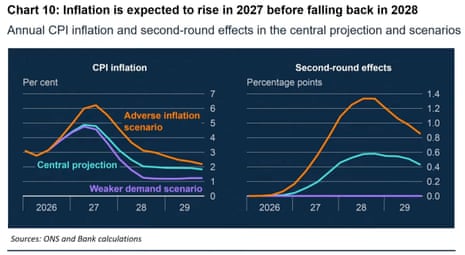
double quotation mark Now, of course, if we continue to get good news on the conflict, that will reduce the risk of further inflationary pressures building. Whilst the Ofgem cap for the first quarter of next year is largely now determined, we would, of course, in this case see lower pump prices.So inflation would peak somewhat below 5%.
The Bank of England has drawn up three scenarios for how the next few years may play out.
Under its adverse inflation scenario, inflation peaks at 6.2% and stays above the 2% target throughout the forecast period.
At least part of the UK's recent economic strength appears to have been driven by AI, Andrew Bailey says.
He says work by the Bank of England staff suggests that just under a fifth of GDP growth since the start of this year has been accounted for by AI-related activity.
Andrew Bailey then hints that the Bank could well raise interest rates again, following today's hike to 4%, unless the Iran war ends.
He tells reporters in London:
double quotation mark Today's increase should not be seen as the first in an inevitable long sequence of hikes. That is not inevitable.But unless the conflict in the Middle East is resolved, neither does it seem likely to be the last increase.
Looking to the economy, Bank of England governor Andrew Bailey points out that inflation causes hardship, “particularly amongst the lower paid and those struggling to find work.â€
Not surprisingly, consumer confidence has recently weakened, Bailey adds.