Introduction: Oil prices rise and Asian stocks fall amid worries over uncertain ceasefire deal
Good morning, and welcome to our rolling coverage of business, the financial markets and the world economy.
Uncertainty over the US-Iran ceasefire deal has triggered a rise in oil prices this morning.
Brent crude, the international benchmark for oil prices, rose by 2.1% to $96.77 a barrel, while New York light crude rose by almost 3% to $97.23 a barrel. Yesterday, Brent crude dropped by more than 10% after initial news of the ceasefire emerged.
Meanwhile Asian stocks have been choppy overnight: Japan's Nikkei has slipped by 0.7% and the South Korean Kospi has dropped sharply by 2%. Both countries are highly exposed to the conflict in the Middle East as they rely on oil and gas supplies from the region.
In China, the CSI300 index fell 0.5% and Hong Kong's Hang Seng also slipped 0.2%.
It comes as investors worry about the ‘fragile' nature of the US-Iran ceasefire deal announced yesterday, as Israel continues its assaults on Lebanon and the impasse in the strait of Hormuz continues.
Jim Reid, a strategist at Deutsche Bank, says this morning:
double quotation mark Those overnight losses follow several indications that the ceasefire isn't holding quite as expected on Tuesday night. For instance, both the UAE and Kuwait said yesterday that their air defences had been intercepting drones from Iran. And on the Iranian side, their Parliament's Speaker Ghalibaf said that three points of the ceasefire agreement had been violated.Moreover, the IRGC warned of a “regret-inducing response†if Israel's strikes against Lebanon didn't stop immediately, whilst the Fars news agency said that the passage of oil tankers through the Strait of Hormuz was halted because of Israel's continued strikes on Lebanon. So collectively, that's raised concern about how durable this ceasefire will prove, particularly with it only being a two-week truce.â€
Reid notes that US president Donald Trump posted on social media a couple of hours ago that US forces would “remain in place, and around, Iran, until such time as the REAL AGREEMENT reached is fully complied withâ€, and that if not military action would be “stronger than anyone has ever seen beforeâ€, and that the US military was “looking forward, actually, to its next Conquestâ€.
double quotation mark He also criticised NATO in a separate post overnight, saying that they weren't “there when we needed themâ€, and called on people to “remember Greenland, that big, poorly run, piece of ice!!!â€. So that raised concerns about a repeat of mid-January, when Trump's call for the US to take Greenland and the threat of European tariffs drove a risk-off move in global markets.
The agenda
-
8.30am BST: Bank of England governor Andrew Bailey appears before the European parliament committee on economic and monetary affairs
-
9.30am BST: Bank of England credit conditions survey for Q1 2026
-
1.30pm BST: US gross domestic product, initial jobless claims, PCE inflation measure and wholesales inventories
-
3pm BST: IMF managing director Kristalina Georgieva expected to deliver a speech on the outlook for the global economy and outline key policy priorities for member countries
Key events
Please turn on JavaScript to use this feature
Strait of Hormuz “is not open” despite ceasefire deal, says UAE oil boss
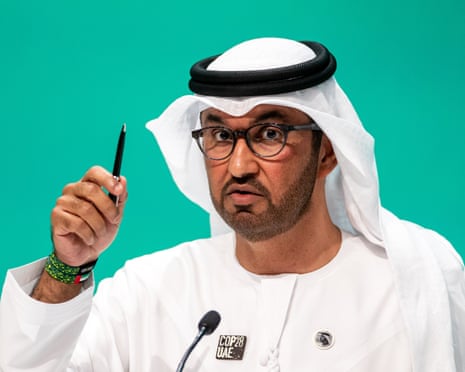
The head of the biggest oil producer in the United Arab Emirates has said that the strait of Hormuz is “not openâ€, despite the US-Iran ceasefire deal.
Sultan Al Jaber, who runs the Abu Dhabi National Oil Company (ADNOC), said in a post on LinkedIn that access through the key shipping channel remained “restricted, conditioned and controlledâ€.
He wrote:
double quotation mark Iran has made clear – through both its statements and actions – that passage is subject to permission, conditions and political leverage. That is not freedom of navigation. That is coercion.
… Conditional passage is not passage. It is control by another name.
The strait must be open – fully, unconditionally and without restriction. Energy security and global economic stability depend on it. The weaponization of this vital waterway, in any form, cannot stand. This would set a dangerous precedent for the world – undermining the principle of freedom of navigation that underpins global trade and, ultimately, the stability of the global economy.
An estimated 230 vessels sit loaded with oil and ready to sail. They, and every vessel that follows, must be free to navigate this corridor without condition. No country has a legitimate right to determine who may pass and under what terms.
Energy producers must be able to swiftly and safely restore production at scale.
He added that ADNOC has loaded cargoes and will expand production within the constraints of the damage it had suffered.
double quotation mark Markets remain at a critical crossroads. The final cargoes that transited the strait of Hormuz before the conflict are now arriving at their destinations.This is where the paper traded markets are meeting physical reality, and the 40-day gap in global energy flows is truly exposed.
The immediate priority is clear: close that gap. Restore the more than 20% of globally traded energy that flows through this corridor. Rebalance markets. Ease the pressure on prices and the cost of living.
This is particularly urgent for Asia, where 80% of these cargoes are bound and half the world's population lives.
… Stability now depends on restoring real flows. Not partial access, not temporary measures, not controlled passage, but full and reliable supply.
That is how we slow the economic shockwave already moving through the system.
Iranian, Greek and Chinese ships among 11 vessels to get through strait of Hormuz

Lisa O'Carroll
Four Iranian, four Greek and one Chinese ships are among the 11 vessels that have been allowed transit through the strait of Hormuz in the 24 hours since the ceasefire.
Their passage barely dents the blockage on both sides of the narrow passage where around 1,400 ships remain anchored.
According to data verified by AXSMarine two eastbound ships, Oman-owned, Lucia and Greek owned, Iolcas Destiny, were given passage from the Gulf in the early hours of Thursday morning despite the Iranian declaration the strait was closed amid concerns over the fragility of the ceasefire.
A further ship which cross from west to east on Wednesday did not identify itself and could be part of a shadow fleet.
AXS said there was a high degree of “spoofing†and signal disruption particularly among vessels anchored in the Gulf, with many reporting false positions.
While the strait has been effectively closed since the outbreak of war, Iran has made concessions to allies including China, Russia, India, Iraq and Pakistan with some Malaysian and Thai vessels granted access after diplomatic talks in the last six weeks.
On 2 April, Iran said it would allow Philippine-flagged vessels to cross following further negotiations.
Fuel prices in the UK rise again
Fuel prices are still rising in the UK, according to the RAC.
Its monitor shows that the average petrol price has risen 0.2% today to 158.03p a litre. Meanwhile diesel has risen 0.3% to 191.11p. They stood at 132.83p and 142.38p respectively before the war in Iran began.
The continued rise may add further pressure on the government to extend its cut to fuel duty. Last week Richard Walker, who is the executive chair of the supermarket chain Iceland and the government's cost of living champion, urged Keir Starmer not to go ahead with plans to raise the levy in September.
However, there have been warnings that tax cuts may be too expensive to keep in place for long.
Stefano Scarpetta, chief economist at the Organisation for Economic Co-operation and Development (OECD), said in an interview with the Financial Times that the “cost of these policies is especially highâ€.

Julia Kollewe
More from Andrew Bailey, the governor of the Bank of England, who is speaking to the EU parliament's committee on economic and monetary affairs in his role as chair of the Financial Stability Board:
Bailey has talked about stablecoins, which are backed by a specific asset, and cryptocurrencies like Bitcoin. He was asked about Iran demanding fees for ships passing through the strait of Hormuz, payable in cryptocurrencies. He said:
double quotation mark I made the distinction earlier between stablecoins, which are designed to be money with assured value, and Bitcoin type crypto which doesn't have assured value.I think the Iranians are clearly referring to the second of those, to the Bitcoin type crypto. What lies behind that is the desire to obscure the transaction… this raises big questions, obviously, about money laundering and about controls and, I've not been involved in what's what's been announced, but it does raise issues.
Discussing private credit, Bailey described it as a “relatively opaque world†and stressed the need for transparency and solid stress testing, because otherwise people might lose faith in the financial system as a whole.
double quotation mark We've obviously had some cases in the US, particularly where private credit has, in a sense, gone wrong, and we've got defaults happening.
This goes back slowly to my my experience in the financial crisis, that there is a risk that when investors start to observe more of these incidents, that begs a bigger question about their confidence in the system as a whole.
I'm not saying this will happen this time, because it depends on how investors react, what they think they're getting. But we have to be very sensitive in terms of stress testing.â€
A week ago, a New York-based private credit investment firm, Blue Owl Capital, imposed a cap on withdrawals after investors tried to pull $5.4bn from two key funds, in the latest sign of crumbling confidence in the unregulated lending market.
There are growing jitters over potentially risky loans arranged by private credit firms, which lend to companies using investor money outside the traditional regulated banking system and are seen as particularly exposed to the AI spending boom.
Oil prices are still rising this morning, as markets question the durability of the ceasefire deal between the US and Iran.
Brent crude, the international benchmark, is now up by about 3% to $97.88 a barrel.
World ‘still with us’ after Trump’s ultimatum on Iran, says BoE governor
Julia Kollewe
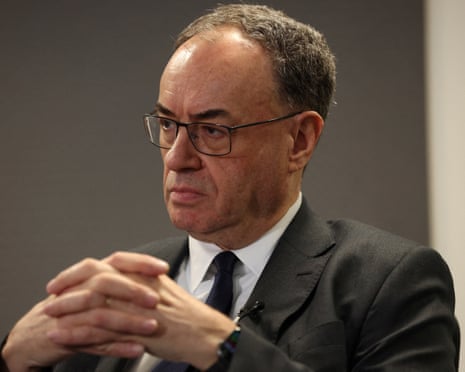
The war in the Middle East has been a “very big shock†but on Wednesday we “found the world was still with us,†although markets remain “very volatile,†according to Andrew Bailey, chair of the Financial Stability Board, an international body that monitors the global financial system.
Appearing before the EU parliament's committee on economic and monetary affairs, the Bank of England governor said:
double quotation mark We've obviously had a very big shock in the last month or so, with the conflict breaking out in the Middle East, that has prompted, obviously, much greater market volatility. I mean, we all have to get up in the morning and find out what's gone on overnight. At least we got up yesterday and found the world was still with us, but it obviously is very volatile. Yesterday was a good day in point to illustrate that.â€
But he added that “the banking system is resilientâ€.
Bailey also said (not speaking in his role as FSB chair) that one of the lessons from the Iran war is that it has changed the economics in favour of renewable energy.
double quotation mark It's a very good environmental argument, don't get me wrong. But there is also an economic argument here as well, because it's certainly the case for the UK that we are still reliant on gas quite often, but less than we used to be, as the marginal source of energy.But the share of renewables has grown, and I know the UK government's very focused on this question as to what we learn from the events we're going through at the moment, what's the right thing to do.â€
Elsewhere this morning, mortgage rates are falling in the UK, according to the data provider Moneyfacts.
It found the average rate for a two-year fixed residential mortgage is now 5.89%, compared with 5.9% yesterday. The average rate for a five-year deal is 5.77%, down from 5.78% yesterday.
That is based on 6,302 residential mortgage products currently on the market, up from 6,284 on Wednesday.
Rachel Springall, of Moneyfacts, said:
double quotation mark Today marks the first time since early March that both the two- and five-year fixed rates fell simultaneously. Although this sounds positive, fixed rates remain around 1% higher than they were at the start of March.It is more likely that lenders will see the latest ceasefire as a period of grace to slowdown the pace of interest rate changes over the next couple of weeks, rather than them moving in their droves to significant rate cuts. Swap rates are still hovering around 4% and really, we need more reassurances on inflation forecasts to give the market a better sense on whether BBR might be increased in the short-term. However, in the longer-term, the tide could turn, and interest rates may come down again if the Strait remains open and the price of oil reduces. It really depends how long such unrest prolongs and its gradual impact to the cost of living.
Spring is meant to be a flourishing season for the mortgage market, especially for those looking to buy their first home. Unfortunately, the mortgage mayhem caused by the unrest in the Middle East led to a flurry of rate hikes by lenders throughout March. Lenders also pulled deals from sale, some temporarily, but it led to an overall reduction of 17% in product choice within the space of a month.â€
Mortgage rates have surged past 5% in the past month, as war in the Middle East prompted fears that higher oil and gas prices would stoke inflation. The uncertainty pushed up the money market swap rates that lenders use to decide rates on their new fixed mortgages.
But City traders pared back their bets for UK interest rate rises this year after the US and Iran agreed to a two-week ceasefire.
Two oil tanker charters renewed at 47% higher rate, says UK ship investor
Tufton Assets, a UK fund that invests in second-hand ships, has just completed charter renewals on two oil tankers: at a 47% higher rate.
The ships, which range from 30,000 to 40,000 deadweight tonnes and are designed to transport refined petroleum products, have had their charters extended by 12 months. Their new rates are now 47% higher at a net $20,738 per day, compared with a previous rate of $14,072.
However, Nicolas Tirogalas, who manages the fund, says the rates were “agreed ahead of the recent escalation of tensions in the Middle East and reflect the strengthening of the product tanker market as a result of vessel shortages and Russian sanctionsâ€.
But more renewals are coming up. He said:
double quotation mark A further eight vessels are due for charter renewals this year and we anticipate achieving higher daily rates on average, generating additional income for the company.â€
There is still much uncertainty looming over the shipping industry, as fears remain around the safety of travelling through the strait of Hormuz.
Susannah Streeter, chief investment strategist at the broker Wealth Club, says that even if shipments resume in the strait of Hormuz, risks won't “disappear overnightâ€.
double quotation mark Tankers may be forced to navigate mined waters and a heightened military presence, all of which will keep insurance premiums high and freight costs elevated.The conflict is already piling on financial pain for consumers, especially motorists. Diesel has jumped above £1.90 a litre – a rise of around 50p a litre in some areas of the UK since the outbreak of the war. Petrol is also up by around 30p a litre. Anyone travelling longer distances on motorways during the Easter holidays will be stung more aggressively, with diesel prices hitting £2 a litre at some service stations.
If the ceasefire holds, prices should start to come down a little, but given how fragile the situation is, we are likely to see volatility for weeks, if not months. Significant damage to key energy infrastructure across the Gulf region is set to keep prices elevated until repairs can be completed, which for some facilities could take years.
Some oil-producing nations, like Saudi Arabia, have more capacity to ramp up output, but it will only be gradual given the huge disruption suffered and will depend on how quickly they can shift the oil. With the Strait of Hormuz set to be on a go-slow at best, even if the ceasefire holds, this will take considerable time to filter through to prices at the pumps.â€
European stock markets open lower
European stock markets are following Asia lower this morning, as some of the optimism from yesterday's rally starts to fade.
The UK's blue-chip FTSE 100 index has slipped 0.1% in early trading, while the German Dax has dropped 0.6%. France's Cac 40 is down 0.3%, and the Italian FTSE MIB is down 0.2%.
The European Stoxx 600 index, which tracks the biggest companies on the continent, is down 0.1%.
Aarin Chiekrie, an analyst at the broker Hargreaves Lansdown, notes that US stock futures are also slightly lower this morning.
double quotation mark While it's been a tough start to the year for equity investors, the bigger picture needs to be kept in mind. The S&P 500 has already rallied more than 7% from its 30 March low and is now down less than 1% year-to-date. While progress towards a more permanent resolution in the Middle East will dominate short-term market moves, it's earning power that drives stock prices in the long term. Some corners of the market have seen their share prices get caught up in the broader market sell-off, despite a resilient or improving earnings picture, so there's something to be said for being greedy when others are fearful.Brent crude prices recovered some of yesterday's sharp losses this morning, moving nearly 2% to around $97 per barrel following further Israeli strikes on Lebanon…Oil prices will likely remain elevated and choppy until a more permanent agreement is struck between all parties, and on that front, US Vice President JD Vance is set to lead a US delegation to Islamabad for direct talks with Iran this weekend.â€
UK mortgage market wobbles amid war uncertainty
Closer to home, uncertainty caused by the war in the Middle East is rocking confidence in the property market.
The Royal Institute of Chartered Surveyors said rising mortgage costs have dented buyer demand for property and is weighing on long-term expectations for house prices.
It found that a balance of 23% of professionals saw house prices falling rather than rising in March, and a balance of 39% said they saw new buyer inquiries falling rather than rising. This is the weakest reading since August 2023.
London, East Anglia, the South East and the South West all posted weaker property price readings than the national average, though Scotland and Northern Ireland continued to report rises.
Tarrant Parsons, head of market research and analysis at Rics, said:
double quotation mark The mood across the UK housing market has shifted markedly over the past couple of months.What had been a cautiously improving picture for activity has been knocked off course by the wider macro fallout from the Middle East conflict, as the renewed deterioration in the mortgage rate outlook has proved particularly challenging.
Indeed, with average fixed rates climbing back above 5% according to some sources, it is unsurprising that buyer demand has softened.
The path ahead hinges on whether or not recent surges in oil and energy costs begin to reverse in what remains a highly uncertain geopolitical environment.â€
Israel instructs Energean to reopen natural gas platform
Perhaps a sign that Israel expects the ceasefire to hold: the Israeli energy ministry has instructed Energean to reopen operations at its Karish natural gas platform, Reuters has reported.
The gas platform, which is off Israel's Mediterranean coast, has been shut down for more than a month since the outbreak of war with Iran.
Mohit Kumar, of the broker Jefferies, says the “fragile†nature of the ceasefire deal has started to show cracks after Iran accused the US and Israel of breaking the terms due to attacks on Lebanon – but that the agreement could still hold.
double quotation mark Despite the fragile nature of the ceasefire, we believe that the truce will hold. Not because we believe that a solution has been found but because of the MAD (mutually assured destruction) principle.…US and Israel have realised that without a solution to cheap drone interceptors and someway to bypass the Strait of Hormuz, it's a war that cannot be won. IRGC will be struggling with a destroyed economy which can pave the path for an uprising later. Hence, need time to consolidate their power particularly after a number of senior leaders have been killed. Given the interest of both parties, we believe that an uneasy truce will hold.
But as argued yesterday, it's an unstable equilibrium. The biggest losers of this arrangement have been the Gulf countries who would face an emboldened Iran. Iran's ideology to export the Islamic Revolution would not bode well for the other gulf countries. Economically too, they have taken a setback with the path of projecting Middle East as an investment hub potentially delayed by a few years.
Hence, we do not see oil going back to pre war levels. We also think that a geopolitical risk premium would need to be priced in different asset classes.
From a market perspective, we have been in the low risk mode but with a positive bias. The positive view remains beyond the war, but we are not ready to sound all clear. Hence for investors who are long risk, we would recommend using yesterdays rally to take some profits which still keeping a positive risk bias. Market positioning is still small short to neutral and hence we would definitely not want to be short this market.
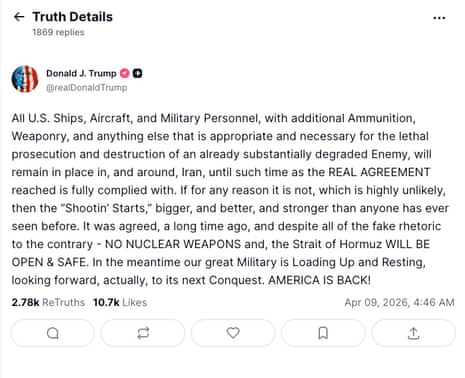
Here's Trump's full post on his social media platform, Truth Social:
double quotation mark All U.S. Ships, Aircraft, and Military Personnel, with additional Ammunition, Weaponry, and anything else that is appropriate and necessary for the lethal prosecution and destruction of an already substantially degraded Enemy, will remain in place in, and around, Iran, until such time as the REAL AGREEMENT reached is fully complied with. If for any reason it is not, which is highly unlikely, then the “Shootin' Starts,†bigger, and better, and stronger than anyone has ever seen before. It was agreed, a long time ago, and despite all of the fake rhetoric to the contrary – NO NUCLEAR WEAPONS and, the Strait of Hormuz WILL BE OPEN & SAFE. In the meantime our great Military is Loading Up and Resting, looking forward, actually, to its next Conquest. AMERICA IS BACK!
Introduction: Oil prices rise and Asian stocks fall amid worries over uncertain ceasefire deal
Good morning, and welcome to our rolling coverage of business, the financial markets and the world economy.
Uncertainty over the US-Iran ceasefire deal has triggered a rise in oil prices this morning.
Brent crude, the international benchmark for oil prices, rose by 2.1% to $96.77 a barrel, while New York light crude rose by almost 3% to $97.23 a barrel. Yesterday, Brent crude dropped by more than 10% after initial news of the ceasefire emerged.
Meanwhile Asian stocks have been choppy overnight: Japan's Nikkei has slipped by 0.7% and the South Korean Kospi has dropped sharply by 2%. Both countries are highly exposed to the conflict in the Middle East as they rely on oil and gas supplies from the region.
In China, the CSI300 index fell 0.5% and Hong Kong's Hang Seng also slipped 0.2%.
It comes as investors worry about the ‘fragile' nature of the US-Iran ceasefire deal announced yesterday, as Israel continues its assaults on Lebanon and the impasse in the strait of Hormuz continues.
Jim Reid, a strategist at Deutsche Bank, says this morning:
double quotation mark Those overnight losses follow several indications that the ceasefire isn't holding quite as expected on Tuesday night. For instance, both the UAE and Kuwait said yesterday that their air defences had been intercepting drones from Iran. And on the Iranian side, their Parliament's Speaker Ghalibaf said that three points of the ceasefire agreement had been violated.Moreover, the IRGC warned of a “regret-inducing response†if Israel's strikes against Lebanon didn't stop immediately, whilst the Fars news agency said that the passage of oil tankers through the Strait of Hormuz was halted because of Israel's continued strikes on Lebanon. So collectively, that's raised concern about how durable this ceasefire will prove, particularly with it only being a two-week truce.â€
Reid notes that US president Donald Trump posted on social media a couple of hours ago that US forces would “remain in place, and around, Iran, until such time as the REAL AGREEMENT reached is fully complied withâ€, and that if not military action would be “stronger than anyone has ever seen beforeâ€, and that the US military was “looking forward, actually, to its next Conquestâ€.
double quotation mark He also criticised NATO in a separate post overnight, saying that they weren't “there when we needed themâ€, and called on people to “remember Greenland, that big, poorly run, piece of ice!!!â€. So that raised concerns about a repeat of mid-January, when Trump's call for the US to take Greenland and the threat of European tariffs drove a risk-off move in global markets.
The agenda
-
8.30am BST: Bank of England governor Andrew Bailey appears before the European parliament committee on economic and monetary affairs
-
9.30am BST: Bank of England credit conditions survey for Q1 2026
-
1.30pm BST: US gross domestic product, initial jobless claims, PCE inflation measure and wholesales inventories
-
3pm BST: IMF managing director Kristalina Georgieva expected to deliver a speech on the outlook for the global economy and outline key policy priorities for member countries



.jpg?disable=upscale&width=1200&height=630&fit=crop "Como a FemTech Portugal está a construir um ecossistema de saúde da mulher")