European stocks fall as ‘Hormuz chaos’ leaves markets on edge
European stock markets have dropped at the start of trading, as last Friday's optimism about a Middle East peace deal evaporates.
In London, the FTSE 100 has dropped by 42 points, or 0.4%, to 10,626 points, away from a six-week high at the end of last week.
Germany's DAX has fallen by 1.3%, and Italy's FTSE Mib is down 1.1%.
The “chaos†over the strait of Hormuz has left the markets on edge, reports Chris Beauchamp, chief market analyst at investing and trading platform IG:
double quotation mark “Friday's euphoria has given way to confusion around the status of Hormuz. While Iran has declared it closed, markets seem to be, as ever during this crisis, looking on the bright side.US futures are down, and Europe is expected to open lower, but most of the gains are still intact. And oil futures aren't back to where they were early Friday. If talks do get underway that will help support risk appetite, but this is far from a foregone conclusion that they will even begin right now.
A clear way out of the crisis is still impossible to foresee, and meanwhile the energy crisis continues to worsen by the day.â€
Key events
Please turn on JavaScript to use this feature
Closing post
And finally… Britain's stock market has closed in the red, as the ongoing closure of the strait of Hormuz worries investors.
The FTSE 100 has fallen by 58.5 points, or 0.55%, to 10,609 points, away from the six-week high struck on Friday evening.
European markets are also down, with the Stoxx 600 having lost around 0.9% in late trading.
The oil price remains up around 5.5% today at $95.20 a barrel, reversing around half its tumble on Friday.
UK month-ahead gas prices are up 3% at around 100p a therm.
Anthony Willis, senior economist at Columbia Threadneedle Investments, says developments over the weekend have confused matters.
double quotation mark Despite the short ‘open' window, we saw very few ships passing through. Some vessels tested navigation channels during the weekend, but many turned back after some ships were fired upon. We also witnessed the US seizing an Iranian vessel in the Gulf of Oman. Last week's progress seems to have reversed.The current ceasefire is due to end on Wednesday, but ahead of that there are expectations of more peace talks. The US is sending a delegation to Pakistan but there is uncertainty around Iran's delegation. Recent rhetoric has been more escalatory with the US once again threatening Iran's infrastructure and the Iranian regime pushing back on comments around concessions on nuclear capabilities.
Our Middle East crisis liveblog has all the latest developments:
The US technology stock index, the Nasdaq, is on track to end a strong run today.
The Nasdaq is currently down 0.55%, or 133 points, at 24,334 points.
Last Friday the Nasdaq posted a 13th consecutive daily climb, a winning streak not seen since early 1992, Deutsche Bank say.
President Donald Trump said it's “highly unlikely†he would extend the two-week ceasefire with Iran if a deal is not reached before it ends.
In a phone interview, Trump said:
double quotation mark “I'm not going to be rushed into making a bad deal. We've got all the time in the world.â€
Bloomberg has more details.
With about an hour's trading to go, European stock markets remain in the red amid ongoing disappointment that the strait of Hormuz remains closed.
Germany's DAX and France's CAC 40 are both down around 1%, while Spain's IBEX is down a little more and Italy's FTSE Mib has lost 1.2%.
The UK's FTSE 100 is down 55 points, or 0.5%, at 10,612 points.
Joe Mazzola, head trading & derivatives strategist at Charles Schwab, says:
double quotation mark “Friday's exuberance quickly became a case of the Monday blues after Middle East anxiety re-ignited over the weekend.The Strait of Hormuz—which Iran said Friday had re-opened—remains closed this morning as the ceasefire clock winds down and Iran gives mixed signals about joining peace talks, though the latest indications point to its participation.
Shares in satellite designer AST SpaceMobile have dropped 8% in early trading, after a satellite launch by Blue Origin was deemed to have failed.
On Sunday, a New Glenn rocket carrying AST SpaceMobile's BlueBird 7 satellite took off from Florida's Cape Canaveral, taking it into orbit. Just not to the correct altitude.
The satellite was due to be used for a space-based cellular broadband network.
AST SpaceMobile says the misplaced satellite will now be ‘de-orbited' (plunged into the earth's atmosphere to burn up).
It says:
double quotation mark During the New Glenn 3 mission, BlueBird 7 was placed into a lower than planned orbit by the upper stage of the launch vehicle.While the satellite separated from the launch vehicle and powered on, the altitude is too low to sustain operations with its on-board thruster technology and will de-orbited. The cost of the satellite is expected to be recovered under the company's insurance policy.
The US stock market has opened in the red (although not falling quite as much as expected).
The S&P 500 share index has dropped by 0.2% after Wall Street opened.
Travel stocks are among the fallers, with Norwegian Cruise Line Holdings down 4%.
Lizzy Galbraith, senior political economist at Aberdeen, says:
double quotation mark “Progress towards a lasting ceasefire between the US and Iran, and re-opening of the Strait of Hormuz, remains a case of two steps forwards, one step back. The ceasefire, currently due to expire mid-week, is extremely fragile. After the US and Iran seemingly declared the strait open Friday, Iran promptly declared it closed again while the US blockade remained in place.At the time of writing, it is unclear if a second round of negotiations will go ahead this week.
One explanation for this diplomatic whiplash is the power vacuum at the heart of the Iranian government. With a high percentage of key leadership killed, it is unclear whether any single figure has the authority and capability to reach an agreement with the US that all parties will follow.
It may also be that both sides are increasing their leverage ahead of the next round of talks while still fundamentally in search of a deal.
As well as the Middle East crisis, investors are also watching developments in the artificial intelligence world over Anthropic's frontier AI model Mythos.
Mythos has been deemed to pose an unprecedented risk because of its ability to expose flaws in IT systems, speaking fears that it poses a cybersecurity threat.
A spokesperson for the Australian Securities and Investments Commission (ASIC) has said that it was closely monitoring the usage of Mythos along with other regulators to assess possible implications for the Australian market, explaining:
double quotation mark “ASIC engages closely with other regulators, government agencies and the financial sector to understand and respond to changing technologies.â€
South Korea's Financial Supervisory Service (FSS) said it held a meeting with information security officials from financial firms last week to review Mythos-related risks.
Record surge in gasoline prices pushed up Canadian inflation
Just in: Inflation in Canada has jumped, as the Iran war drove up energy costs.
The Canadian Consumer Price Index (CPI) increased 2.4% year over year in March, up from an increase of 1.8% in February, Statistics Canada reports, adding:
double quotation mark Driving faster price growth in headline inflation were higher prices for energy, especially gasoline, due to the conflict in the Middle East. Excluding gasoline, the CPI rose at a slower pace year over year in March (+2.2%) compared with February (+2.4%).
The inflation report shows that energy prices rose 3.9% on a year-over-year basis in March, or by 13.1% on a monthly basis.
Canadian motorists were hit by a record increase in petrol prices, the report shows:
double quotation mark Higher prices for gasoline were the primary driver of the year-over-year acceleration in the CPI, as consumers paid 5.9% more for gasoline in March than they did in the same month the previous year. Prices surged 21.2% on a monthly basis, the largest price increase for gasoline on record, due to the supply shock resulting from the conflict in the Middle East.
Wall Street is set to drop when trading begins in New York in just under an hour and a half.
The Dow Jones industrial average is on track for a 0.6% drop, with the broader S&P 500 fugures contract down 0.5%.
That will wipe out some of the gains last Friday, when relief that the strait of Hormuz had been reopened swept through markets.
Fawad Razaqzada, market analyst at Forex.com, says:
double quotation mark Well, that didn't last long, did it? The much-talked-about “reopening†of the Strait of Hormuz barely made it through a day before Friday's tensions came straight back into play.Still, there's a sense that both sides might be posturing — talking tough with the deadline looming to strengthen their negotiating hands. The clock's ticking again, with talks supposedly lined up for tomorrow in Islamabad. That said, Tehran isn't exactly sounding encouraged: the Foreign Ministry has made it clear they've had no serious offers on sanctions relief, and there's still no decision on the next round of US negotiations.
China’s Xi says normal passage through Strait of Hormuz should be maintained
Chinese president Xi Jinping has weighed in on the Middle East crisis today, saying normal passage through the Strait of Hormuz should be maintained.
Xi made the remarks during a phone conversation with Saudi crown prince and prime minister Mohammed bin Salman Al Saud, state news agency Xinhua reported.
China is the world's largest importer of oil through the Strait of Hormuz, but its booming electric car sector means drivers are better insulated from the crisis than in other countries.
The European Union is planning to propose measures on Wednesday to “optimize†jet fuel distribution among member states and help source alternative supplies, according to Bloomberg.
With energy flows through the Strait of Hormuz still at a standstill, pressure on EU fuel supplies is intensifying.
Bloomberg adds:
double quotation mark The commission will also issue guidance next month outlining flexibilities in existing legislation, concerning areas such as airport slots and the consequences of flight cancellations in the event of fuel shortages.It will also address so-called fuel tankering — where aircraft load extra fuel at the point of departure to avoid buying pricier fuel at their destination.
The London stock market has dropped further through the morning, after Iran indicated that it wasn't planning to take part in new peace talks after US forces seized an Iranian flagged ship over the weekend.
The blue-chip FTSE 100 share index is now down 71 points, or 0.67%, at 10,595 points – with copper producer Antofagasta (-4.5%) leading the fallers.
UK housebuilder have also dropped, with traders anticipating that they will suffer from higher mortgage rates, as the jump in the oil price pushes up inflation expectations.
Esmail Baghaei, Iran's foreign ministry spokesperson, has been quoted by Al Jazeera as having said that Iran has no plans for a new round of talks with the US, saying Washington has violated the agreement from its implementation.
The spokesperson also said Tehran can't forget US attacks on Iran during previous diplomatic talks as he insisted that Iran will continue defending its national interests.
Reuters: Shipping traffic remains at virtual standstill through Hormuz
Shipping traffic through the Strait of Hormuz remained at a virtual standstill on Monday with just three crossings in the space of 12 hours, according to shipping data.
Reuters has the details:
double quotation mark The oil products tanker Nero, which is under British sanctions for Russian oil activities, left the Gulf and was sailing through the Strait, according to satellite analysis from data analytics specialists SynMax and tracking data from the Kpler platform.Two other ships – a chemical tanker and a liquefied petroleum gas (LPG) tanker – sailed into the Gulf through the critical waterway separately on Monday, the data showed.
UK petrol and diesel prices have dipped slightly, extending a drop that began last week.
RAC head of policy Simon Williams has the details:
double quotation mark “Pump prices came down very slightly over the weekend. Petrol has now reduced by more than half a penny (0.65p) since it peaked last Wednesday (15 April) and diesel by a penny (1.06p).The RAC's analysis of wholesale data shows that the drop ought to accelerate this week as more retailers buy in new supply at lower costs.â€
However, the average price of petrol is still 18% higher than before the Iran war began, while diesel is more than a third higher.

Property asking prices rise in April despite higher UK mortgage rates
The Iran crisis hasn't deterred UK homeowners from lifting the average asking price on British property.
Average new seller asking prices rose by 0.8% (+£2,929) in April to £373,971, new data from Rightmove shows, below the long-term April average of 1.2%.
Rightmove reports that the UK housing market has remained “surprisingly resilient†despite the jump in mortgage rates since the Middle East crisis began.
But… prices are rising fastest at the top of the market, where buyers are more likely to be paying cash, and in cheaper parts of the country (where a smaller mortgage would be needed).
Colleen Babcock, property expert at Rightmove, explains:
double quotation mark “With mortgage rates remaining elevated due to the war in Iran, it's not a surprise that price growth is proving strongest in parts of the market less exposed to higher borrowing costs, such as top-of-the-ladder homes, while sectors more exposed to interest rates are seeing slower momentum.Across Great Britain, Scotland stands out as an example of resilience, with average prices rising by over 4%. Lower average asking prices and a faster home-buying process continue to support price growth in the Scottish market.
However, for most of the market, the combination of rising mortgage rates and the number of homes for sale being at its highest level for the time of year over a decade, means that competitive pricing is crucial for sellers looking to attract buyer interest and secure a sale this spring.â€
UK consumer confidence hits 33-month low
UK households' confidence has fallen to a near three-year low as people grow more concerned about inflation and the jobs market.
Data provider S&P Global has reported that its Consumer Sentiment Index (CSI) survey has dropped to a 33- month low in April, dropping to 42.3 points from 44.1 in March.
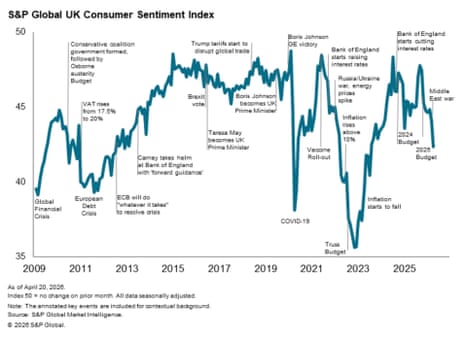
Maryam Baluch, economist at S&P Global Market Intelligence, says:
double quotation mark “Consumer sentiment weakened further at the start of the second quarter, as the conflict in the Middle East weighed heavily on confidence. Views on the labour market soured for the first time in almost three years, while all other measures signalled more acute drags on overall sentiment, underscoring a growing unease among households.“Increased energy-market disruption raises the odds of further spikes in fuel and utility bills, with headwinds keeping near-term inflation stickier than policymakers would like. Against this backdrop, households' rate expectations have turned more hawkish, with a growing share of households now anticipating a tightening of monetary policy by the Bank of England.
“The strain on finances and an uncertain central bank policy outlook is showing up in consumer behaviour as households bear down on spending, particularly on big-ticket items, while running down savings at the fastest pace in a year. Debt undertakings, too, edged higher with the need for loans growing to the greatest extent in over two-and-a-half years.â€
The renewed tensions in the Middle East have pushed the US dollar up to a one-week high against a basket of other currencies.
The dollar index is up 0.2% to its highest level since last Monday.
That's nudged the pound down to below $1.35.
BoE deputy governor: Middle East conflict increases dangers of financial risks crystallising
The Bank of England's deputy governor is warning that vulnerabilities in the financial world could lead to “a rocky ride†in the markets.
Sarah Breeden has singled out private credit markets, leveraged government bond markets and stretched asset valuations as three risk factors – should they all crystallise together, there could be a
Speaking at the HLS-PIFS Symposium on “Building the Financial System of the 21st Century: An Agenda for Europe and the United States†today, Breeden points out that the global financial crisis showed that crises often involve multiple vulnerabilities crystallising together.
Breeden says:
double quotation mark Across all three of these risks you can hear echoes of the past. The combination of leverage, complexity, concentrations and opacity rhyme with the vulnerabilities brought about by the rise of CDOs in 2007 and, more distantly, the development of investment trusts in 1920s. All at a time when the disconnect between high risky asset prices and real economy uncertainty seems marked.I am not predicting the next crisis. But history suggests that when these conditions coincide, the system becomes more fragile.
The conflict in the Middle East raises the odds that one or more of these vulnerabilities could crystallise at the same time. Shocks to growth, inflation and interest rates hit all borrowers simultaneously. Because the system is interconnected, stress in one area can amplify behaviour in others.
UK government bond yields rise amid Iran conflict and Mandelson scandal
UK bond prices are weakening in early trading, hit by geopolitical tensions and domestic political uncertainty.
This has pushed up the interest rate (yield) on short and long-dated British bonds.
The yield on 10-year UK bond yields are up 5 basis points to 4.8%, while shorter-dated two-year bond yields are also up 5bps to 4.16%.
US government bond yields have also risen, but not by quite as much.
The higher oil price will add to inflationary pressures, potentially leading to higher interest rates.
Bond investors will also be watching the UK parliament today, where prime minister Sir Keir Starmer will explain to MPs how Peter Mandelson was appointed as the UK's ambassador to the US having failed his vetting (as the Guardian revealed last week).
Richard Flax, chief investment officer at European digital wealth manager Moneyfarm, says this latest UK political scandal has brought renewed attention to the link between politics and bond markets, saying:
double quotation mark The Prime Minister is facing another tense period, between the latest revelations over Peter Mandelson and the prospect of difficult local elections in early May. Looking at prediction markets like Kalshi or Polymarket, we see that bettors reckon it's 50-50 that Keir Starmer will still be in office in September.We think this sort of uncertainty will make bond investors wary. Most replacements for Starmer within the Labour party would probably like to spend more freely than the current administration, suggesting higher taxes or a larger deficit. We'd argue that some of this is already reflected in starting UK government bond yields, which are high compared to their developed market peers. But we'd still prefer to take our UK government bond exposure in shorter-dated bonds, rather than add to longer-dated positions that could face more volatility.
The pound has also dropped by around 0.15% against both the US dollar and the euro.