Britain issues costliest five-year debt since 2008
Britain has successfully sold more government debt this morning, but at the highest price since the financial crisis almost two decades ago.
The Debt Management Office sold £4.5bn of 5-year debt at an average yield of 5.036%, the highest since 2008, Reuters reports.
There was plenty of interest in the gilts – perhaps not surprising, given the lucrative yields the DMO was prepared to pay. Investors bid for 3.51 times as much debt as was available, allowing the DMO to pick the best offers (ie, the investors offering to accept lower yields).
Key events
Photos: Tax the super-rich!
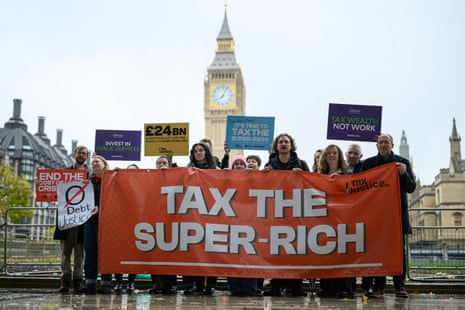
A group of campaigners gathered in Parliament Square today to urge the government to tax the super-rich in tomorrow's budget.
Campaigners from civil society organisations including Tax Justice UK, Patriotic Millionaires UK, and Positive Money came together to call on prime minister Andy Burnham and chancellor John Healey to tax the richest to fund support for those suffering from the cost of living squeeze.
Faiza Shaheen, executive director at Tax Justice UK, said:
double quotation mark With his first Budget, Andy Burnham doesn't have to wait for an election to improve people's lives and get on with his mission of ending neoliberalism. If his words are to be trusted, his Chancellor needs to fund widespread cost of living support, at the same time as long-term investment that breaks the cycle of essentials in Britain costing too much. And that starts with taxing extreme wealth and profiteering companies – so cash goes into public services and every corner of the UK, rather than offshore accounts and shareholders' pockets.

The UK stock market is hoping for a budget that “does no harmâ€, reports Sue Noffke, manager of the Schroder Income Growth Fund.
That may sound rather unambitious, but after two tax-raising budgets from Rachel Reeves the City would prefer a fiscal event that was light on fireworks, but with some growth-friendly measures.
Noffke explains:
double quotation mark After two years in which businesses have absorbed significant increases in costs and taxation, another broad increase in the corporate burden would risk undermining the investment and growth the Government wants to encourage.“There are, however, areas where policy could make a positive difference. For housebuilders, we will be looking closely at the detail of the Your First Home scheme and whether it can provide a meaningful stimulus to new-build demand and housing supply. More broadly, additional investment channelled through public financial institutions into areas such as infrastructure, defence, AI and energy could create opportunities for UK-listed companies, particularly if it succeeds in crowding in private capital.
“Ultimately, UK companies need greater policy stability and confidence to invest. A relatively uneventful Budget that delivers that would not be a bad outcome.â€
We have some better economic news from the US.
US consumer confidence has risen in October for the first time in four months, as Americans grow more optimistic about the job market and business conditions.
The Conference Board's gauge increased 7.5 points to 91.7, the highest since June and beating forecasts.
“Consumer confidence advanced in October, driven primarily by improved perceptions of current and expected business conditions,†said Fergus McCormick, senior economist, global indicators at The Conference Board, adding:
double quotation mark “The recovery was in line with retail gasoline prices easing from September to October. Yet, despite the increase in October, consumer confidence remained on the long-term downward trend that's persisted over the past few years. Consumers planned less spending on services and durable goods over the next six months. This likely reflected higher price levels and persistent inflation, which eroded consumers' purchasing power.â€
Britain's logistics industry has been cheered by reports that chancellor John Healey will retain the current freeze on fuel duty in tomorrow's Budget.
This wouldn't be a terribly surprising development – it's become a modern tradition that a chancellor lays out plans to raise fuel duty in future years, only to bottle it when the moment arrives.
Ben Fletcher, chief executive of business group Logistics UK, says:
double quotation mark “Logistics businesses across the UK will be hoping that today's media reports about the continued freeze in fuel duty prove to be accurate. Retaining the current 5p per litre cut in tomorrow's Budget would be a pragmatic measure that keeps trade moving, supports growth in every postcode and avoids adding further inflationary pressures at a time of rising costs for consumers and businesses. We believe the case for maintaining the current Fuel Duty rate is clear as businesses continue to face significant cost pressures and economic uncertainty.â€
Back in the markets, Wall Street has opened higher as tech stocks rebound from their recent losses.
The Nasdaq share index has gained 1%, up 250 points at 26,420 points. AI cloud computing operator Nebius is leading the risers, up almost 9%.
The S&P 500 share index is up a more modest 0.5%.
Oil falling amid hopes of Middle East de-escalation
The rise in government bond yields has been driven by inflation fears, due to the jump in the oil price this year.
And there are encouraging signs today that energy prices are falling.
Brent crude is down 1.6% at $113.91 a barrel, driven by a diplomatic push to de-escalate tensions between Saudi Arabia and Iran.
Yesterday, representatives from Saudi Arabia, Turkey, Pakistan and Iran met in Tehran; Iran's Foreign Minister Esmaeil Baqaei said the talks were a step toward regional security cooperation.
According to Reuters, Iranian Security Council chief Mohsen Rezaei on Tuesday met Supreme Leader Ayatollah Mojtaba Khamenei, with state media reporting that Khamenei had emphasised the importance of pursuing Iran's interests and maintaining its conditions for ending the war.
Over in the US, new home sales have stumbled as Americans have wrestled with higher interest rates.
New single-family home sales decreased by 0.6% in September to an annualized rate of 676,000, according to figures released today by the federal government.
If Chancellor Healey can deliver the dull budget the market expects on Wednesday then the UK will be rewarded with lower gilt yields, says Matthew Amis, investment director, rates management at Aberdeen Investments:
double quotation mark “It's been a year of negative gilt headlines. The rise in oil and gas has put pressure on gilt yields, which has impacted everything from Government borrowing to mortgages. In all this negativity what hasn't been reported is that gilt yields have surprisingly held up okay. When we look at gilt yield moves we don't simply view them in isolation. We have to view them vs our US and European peers. If UK yields move in isolation, the UK has a problem. If yields move in line, yes the yield move is a negative but it's a global story.Since the political volatility of May, gilt yields have been relatively well behaved. Against both Germany and US, gilts have remained in recent historic ranges. The big move has been against France. If Chancellor Healey needs any reminder of what can happen to gilt yields if you lose control of the fiscal message then the French OAT move is exactly that. In May, UK 10 year yields were approximately 1.30% higher than French yields, going into the budget they now trade only 0.30% higher; a huge move.
The UK bond market is pretty quiet ahead of tomorrow's budget.
The yields on long-dated gilts are down slightly, having already dropped back from the multi-year highs struck earlier this autumn.
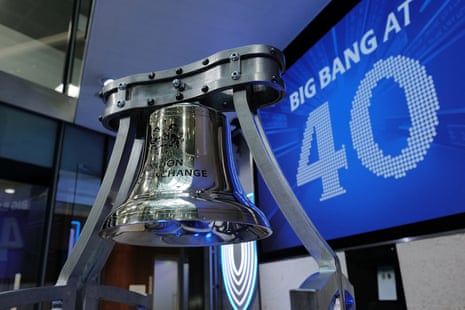
LSE marks 40th anniversary of the Big Bang
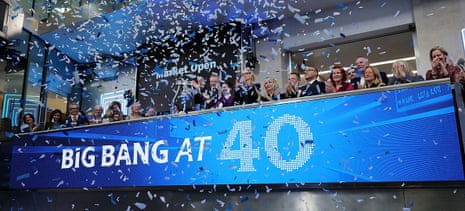
London's stock market has been marking the 40th anniversary of the Big Bang – the sweeping, Thatcherite deregulation of the London Stock Exchange.
The Big Bang brought several fundamental changes to the City, including the end of fixed fees for share trading, allowing firms to operates as both brokers and market-makers, and bringing in electronic trading.
It also allowed foreign firms to buy UK stockbrokers, paving the way for the takeover of UK banks by (largely) American rivals.
To mark the occasion, this morning's opening ceremony at the London Stock Exchange rang its new bell for the first time. This bell, the LSE says, is “a symbol of its heritage, ambition and the market community.â€
It's unfortunate that the market promptly fell by 1%, but we can blame HSBC for that!