Introduction: Global stocks tumble as AI panic grips markets
Good morning, and welcome to our rolling coverage of business, the financial markets and the world economy.
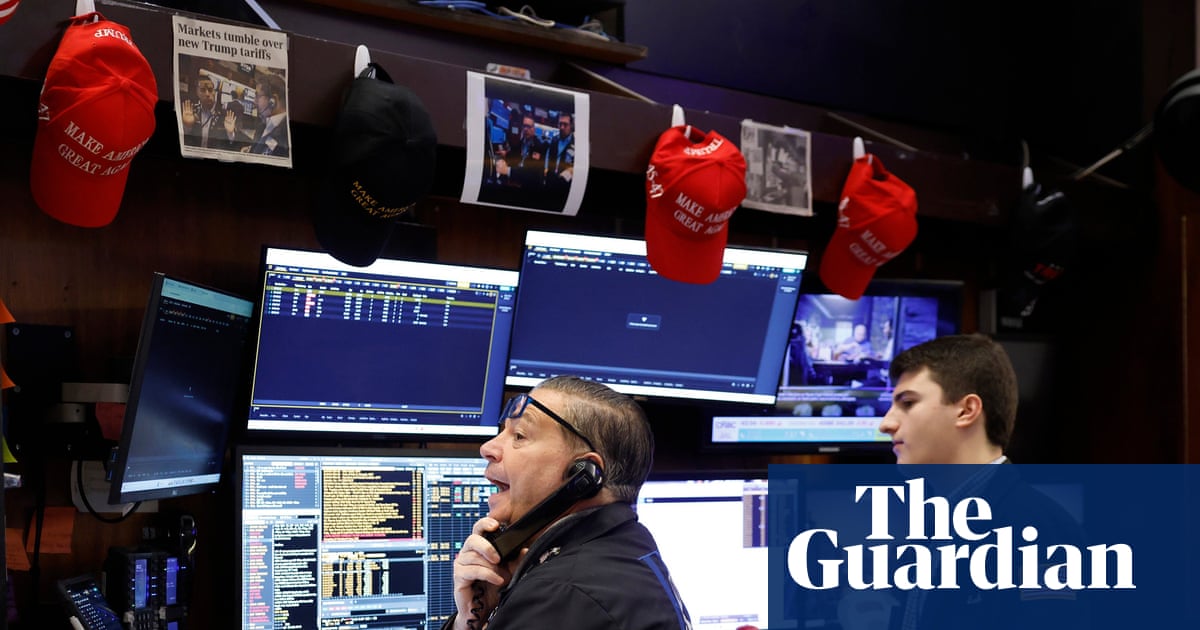
Fears that the Democratic Party's blue wave in this week's midterm elections will sink the AI investment boom are roiling markets, following heavy losses on Wall Street last night.
Asia-Pacific markets are a sea of red (unlike the US election map on Tuesday night!), as investors ditch tech stocks after more than $3.2tn was wiped off the US stock market yesterday.
Today, Japan's Nikkei stock index has slumped by almost 6% – its worst drop since April 7 2025 during the ‘liberation day' tariff panic.
South Korea's KOSPI is down 6.7%, and Taiwan's TAIEX has dropped by 4.5% in a broad rout.
Christopher Forbes, head of Asia and Middle East at CMC Markets, called the market action “a bit of a disasterâ€, explaining (via Reuters):
double quotation mark “(Clients) were long index, long stocks, and they all got carried out.“All night, all day – we had client margin calls, client complaints, … because it's a very emotional thing, right? People are wedded to their positions and views on a stock or outcome and you're telling them, look, you've just lost money.
“And it's not just a slap in terms of valuation. It's basically a whole policy and six-year structural shift that says we're now going to pause, we're now going to cool AI, we're now going to cool data centres, approvals and equity capital markets.â€
After months of warnings that AI valuations were too high, and that the bubble might burst, US investors dashed to the exits en masse yesterday. The Nasdaq tech index slumped by 5.5%, while the Dow Jones Industrial Average (DJIA) dropped 1,833.06 points, or 3.44%, and the S&P 500 lost 4.36%.
Memory chip makers, who had been profiting from the AI boom, led the fallers – SanDisk slumped 22% and both Micron and AMD lost 17% of their value.
Chip giant Nvidia led the fallers on the DJIA, down over 9%.
Analysts pointed to policy uncertainty as Democrats are more critical of data centres, which could slow the rollout of AI investment – especially given public opposition to the sector.
Kyle Rodda, senior financial market analyst at Capital.com, says it was a “brutal sell-off†as fears about the future of the AI buildout gripped the markets.
double quotation mark The tumble in tech stocks that took hold in the immediate aftermath of the US midterm elections resumed as investors contemplated what a Democrat-controlled Congress may mean for tech regulation and the overall AI boom.The regulatory and political risks arise at a time when the proverbial AI trade was already on shakier foundations. Earnings season has been an overall disappointment for the markets, with Magnificent Seven results so far undershooting growth expectations and flashing warning signs that the pace of AI spending is slowing down.
So, it could be a ‘tin hats on' day in the markets. Investors will also be watching the latest US jobs report, for clues into the health of America's labour market.
The agenda
-
7am GMT: Lloyds house price index
-
9am GMT: UN's FAO food price index
-
1.30pm GMT: US non-farm payrolls jobs report
-
3pm GMT: University of Michigan's US consumer confidence report
Key events
Hargreaves Lansdown: our clients are buying the dip
Trading platform Hargreaves Lansdown reports that its clients have been “buying the dip†– the practice where investors pile in when a stock falls to tempting levels.
Anna Macdonald, investment strategy director at Hargreaves Lansdown, suggests this week's tech selloff (which is already unwinding) is a buying opportunity:
Macdonald says:
double quotation mark “Trading interest in overseas AI and technology companies has been growing all week. We've seen some larger investors taking risk off the table, but the average trade has been a buy with Nvidia, SpaceX, Micron, AMD and Alphabet making up the top five. Nvidia and SpaceX are the headline names, while Micron and AMD give investors exposure to the hardware side of the story. Alphabet is interesting too, as its shares were marked down after disappointing numbers and clients have used that as an opportunity to buy.Overall, many of our clients are taking a long-term view and see this as a moment to get back into some of these names at a cheaper entry point.
Yesterday's sell-off looks like an overreaction. We've seen these wobbles before and we'll see them again, but investors need to focus on the fundamentals. Demand for AI isn't going away, and we expect the newly elected US officials to take a pragmatic approach to the buildout.
For patient investors, this is an opportunity to invest in high-quality companies at valuations we haven't seen in a long time.â€
[We don't do investment advice here at the Guardian, beyond Caveat emptor, dear readers.]
After a slow start, the S&P 500 index of US stocks is rising, up 1% today.
Only seven of the 30 companies which make up the Dow Jones Industrial Average have risen in early trading.
Nvidia (now +6.8%) are the top riser, followed by Alphabet (+2.2%), Caterpillar (+2.1%), Goldman Sachs (+1.2%), Cisco (+1%), Amazon (+0.6%) and Chevron (+0.1%).
So, four tech companies, plus construction equipment maker Caterpillar – who has benefitted from demand for its diggers and power generators in the AI rollout boom.
US tech stocks open higher after Thursday’s rout
Ding ding goes the Wall Street opening bell, and trading is underway after the US stock market's most bruising day in 19 months yesterday.
And it's a mixed picture!
Tech stocks are rising, lifting the Nasdaq up by 1.2% in early trading. AI-linked stocks such as AMD (+8.1%), SanDisk (+8.3%) and Nvidia (+6.5%) are among the top risers.
But the much-storied Dow Jones Industrial Average (DJIA) is moving the other way, down 1% at the open. It's being dragged down by old-economy stocks such as Nike (-3.5%), Walmart (-3.2%) and McDonalds (-3.1%).
Reminder: Yesterday the Nasdaq index slumped by 5.5%, while the DJIA dropped by 3.44%. So this is only a small recovery for the Nasdaq, and further pain for the Dow.
Copper is on course for its biggest weekly drop since March, dragged down by the rout in technology stocks.
Benchmark three-month copper on the London Metal Exchange has dropped by 0.5% to $13,775 a metric ton today, and heading for a 2.6% weekly loss.
Copper is essential for electrification and AI infrastructure such as data centres, as well as the fast-growing renewable energy industry.
All eyes are turning to the New York stock exchange, where trading begins in less than 20 minutes time.
After its worst day in 18 months, Wall Street appears to be heading for a mixed open.
The tech-focused Nasdaq is set to rise by 1.5% according to the futures market, while the Dow Jones industrial average (which tracks 30 large companies) could fall 1%.
The S&P 500, which is a broad measure of stocks on the index, is forecast to open a little higher….
Hot jobs report ‘a problem’ for tech stock bloodbath
It may seem counter-intuitive, but today's strong-looking US jobs report could be bad news for technology stocks.
That's because the US Federal Reserve is more likely to raise interest rates if it believes the labor market can take the strain.
So while the US economy might be stronger than feared, that could lead to higher interest rates – which are monetary kryptonite for tech stocks.
Why? Because technology companies are valued on the promise of bumper earnings in the future (particularly in the nascent AI industry!), and higher interest rates make those future earnings worth less today (because you could just get a higher return from holding a bond, or even cash savings).
Nic Puckrin, a former Goldman Sachs analyst, says:
double quotation mark “The jobs report came in hot and that's a problem for a tech sector that's already in the middle of one of its biggest bloodbaths in history. It paves the way for rates to rise again in December and remain higher for longer – all bad news for tech valuations and the increasingly debt-fuelled AI buildout, especially now the sector is already being battered by expectations of stricter policies from the new Democratic Congress.The numbers give the Fed carte blanche to prioritise inflation over jobs, so ordinary Americans should prepare for a 0.25 percentage point rate hike in December. That means higher borrowing costs, more upward pressure on mortgage rates and less chance of a Santa rally for the stock market. However, it could also mean better returns on cash savings.
US workers' wages continued to lag behind inflation last month – one reason the Republicans did so badly in the midterm elections.
Over the past 12 months, average hourly earnings have increased by 3.1%, today's jobs report shows – that's below September's annual inflation rate of 3.7% (which may rise to 4% in next week's October data).
Where did the US economy add jobs last month
Employment in professional and business services increased by 70,000 in October, well above the average monthly gain of 15,000 over the prior 12 months.
Health care added 42,000 jobs in October, with employment gains in hospitals (+16,000), home health care services (+11,000), and outpatient care centers (+5,000).
Transportation and warehousing added 25,000 jobs, due to growth in couriers and messengers (+17,000) and air transportation (+4,000).
Manufacturing employment rose by 19,000, with job gains in computer and electronic product manufacturing (+7,000), machinery manufacturing (+4,000), and primary metal manufacturing (+4,000).
US unemployment rate down to 4.1%
The US unemployment rate has fallen too, to 4.1% from 4.2% in September.
The BLS reports there were 7.1m unemployed people in the US in October, and points out that the jobless rate has remained in a narrow range of 4.1% to 4.3% since March.
US jobs report beats forecasts
Newsflash: The US economy added many more jobs than expected in October.
Total nonfarm payroll employment rose by 165,000 in October, the US Bureau of Labor Statistics has reported, smashing forecasts of a 65,000 gain.
Employment increased in professional and business services, in health care, and in transportation and warehousing, the BLS says.
September's jobs report has been revised up too – to show 60,000 new jobs were created, up from the first estimate of 29,000.
August was also stronger than first thought – with 186,000 new jobs, up from 133,000.
The tumble in the value of technology companies comes at an unfortunate time for Anthropic, the AI firm behind the Claude chatbot.
Anthropic is preparing to float on the US stock market, and had been aiming for a blowout valuation of $1.5 trillion.
But if an AI bubble appears to be popping, surely investors will push for a lower price?
Bloomberg have reported that investors had previously told bankers running the IPO that their estimate of a fair valuation had dropped to around $1.4 trillion, adding:
double quotation mark Some potential backers are discussing a $1.2 trillion to $1.3 trillion range for the company, according to a person familiar with the matter, who asked not to be identified as the information isn't public.